
From the Head's Study: What do teachers make?
Over ten years ago now, when I was perhaps feeling a little disingenuous with my chosen profession, in an extremely well-timed start of year bid to pep the staff room up, my Principal at the time showed us a video. It was of the American Poetry Slam champion, Taylor Mali, and entitled “What Do Teacher’s Make”. He later went on to write the book: “What Do Teacher’s Make?: In praise of the greatest job in the world” and I often return to his video. His famous response to the question of a dinner party guest being derogatory about the financial recompense his loved profession could expect, and more broadly about the profession, by asking “C’mon Taylor – whaddaya make?” is both witty and defiant.
Because, if we are honest, very few of us chose teaching for the pay. Or the paperwork, spreadsheets, policies, data dashboard, risk assessments or administrative processes, to be honest!
We became teachers because, we wanted to make a difference… whether to an individual, a group, or more widely than that.
And a lot of us started off starry eyed and convinced that we would make that difference. I still have in my office a small version of a poster on the wall of the first school I taught at:
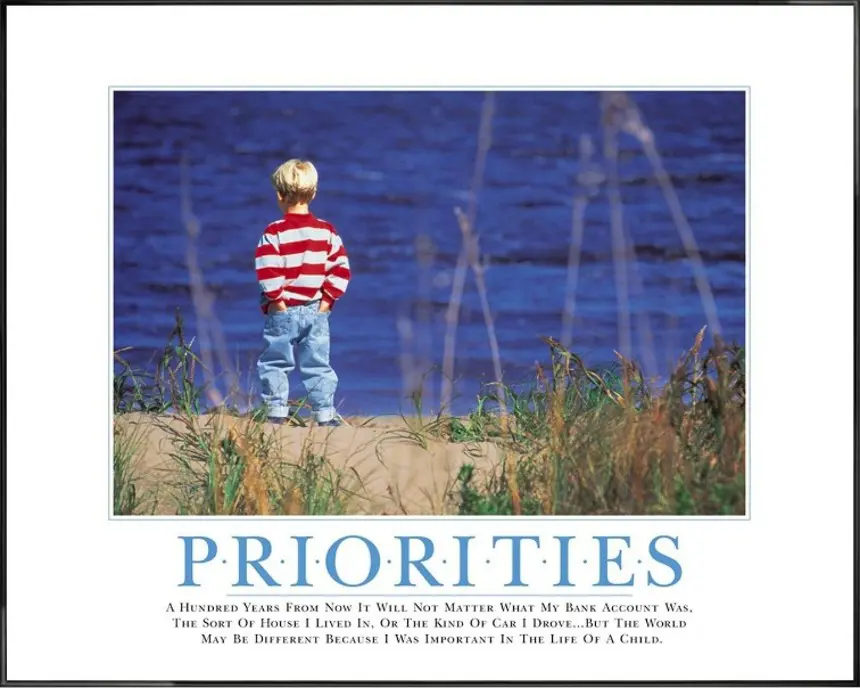
"the world may be different because I was important in the life of a child."
And that deep, heartfelt intent has ebbed and flowed over my career if I’m honest, depending on what was going on in the school I was at, or indeed in my own life. But if or when I ever lost sight of it, then watching Taylor Mali espouse “I make a godd*mn difference, now how about you?” never failed to set me back on track.
And that difference is what we hope to pass on. At its heart, teaching has never really been about delivering content, and in today’s society information has become increasingly accessible. Facts can be found in seconds. Answers arrive instantly.
What remains irreplaceable, however, is the human relationship at the centre of learning that means that any good school will never be placed by AI equivalents. And teachers sit at the heart of that.
The teacher who notices the child who has gone unusually quiet, who encourages the student convinced they are "just not good at maths", who celebrates a small success no one else noticed. The teacher who quietly refuses to give up on someone who has given up on themselves.
These moments rarely appear in league tables. They are not measured in percentages or grades and are fair less easy to “market”. Yet they are often the moments that young people remember for years afterwards.
At the start of our INSET last week, I played Taylor’s video to my staff, and many thanked me afterwards. Yes, some had seen it before, but to be reminded of why we are here and what should sit at the heart of what we do is a great way to recentre, especially as we set about new initiatives and taking our school to the next level.
As teachers, we are privileged to work at one of the most important intersections in society - where young people are becoming who they will be. Every day we are helping children develop not only knowledge but judgement. Not only skills but character.
We teach algebra and Shakespeare, chemistry, languages and music. But we are also teaching pupils how to recover from disappointment, how to work alongside people who are different from themselves, how to show kindness, how to persevere when something is difficult, and how to carry themselves with integrity.
The truth is that education has always been about far more than examination results, and any institution, leader or parent who believes otherwise risks missing its broader and more profound purpose.
Of course results matter. Results open doors and create opportunities. But the greatest test of our work is not what young people know at nineteen. It is who they are as a person at age twenty-nine, forty-nine or seventy-nine. Do they contribute? Do they care? Do they show courage? Do they seek truth? Can they be trusted?
That is why, amidst any conversations about strategy, curriculum development, technology and performance measures, it is worth returning to first principles that brought those of us who live and breath our profession into it in the first place:
- Every child deserves someone who believes in them.
- Young people need guides as much as they need information.
- Education remains one of the most powerful forces for transforming lives.
And we gain a spark of joy to remember that every day brings the possibility of a breakthrough, a discovery, a spark of confidence, a moment of understanding.
We make a difference in the lives of young people every day. That is why ours is not simply a job, but a profession, a calling and a conscious life choice.
Discover more at
Pocklington