

From the Head's Study - Cricket Life Lessons
There are certain sounds that signal the arrival of summer at a school, and the unmistakable crack of bat on ball is a notable one. Summer is not just the season in which cricket is played, but the spirit it invites and the pace at which it occurs, prioritising patience over urgency and the respectfully clapped appreciation of another’s success.
As a family, we are cricket fans, which was only exacerbated during our time in Australia, where the game is woven deeply into national life. There, cricket is not simply a summer sport, but the language of summer. It is spoken in back yards, using the wheelie bin as stumps, on the beaches where passing dog walkers double as temporary deep fielders, in city parks amongst the publicly available gas barbeques, on the numerous council sports fields scattered throughout cities, and of course, in stadiums. In our family we each fulfil the core roles of player, coach, scorer and umpire. I shall leave you to determine which is which.
In our kitchen, we have a canvas which is entitled “Cricket Life Lessons”, that is often referred to tongue-in-cheek, but when you pause to study it, has a lot to offer.
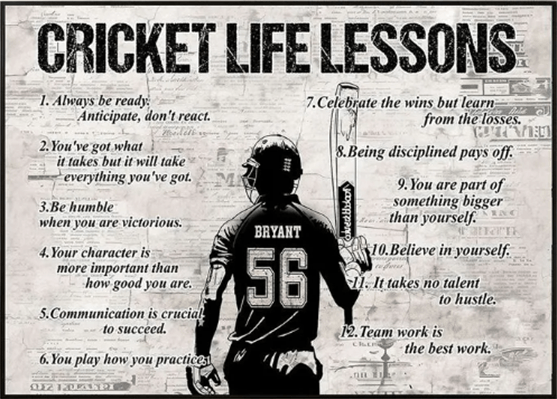
Cricket, perhaps more than any other school sport, teaches the importance of being ready. A batter learns quickly that success comes not from reacting late, but from anticipating what might come next. A fielder discovers that concentration must be sustained even when the ball has not come their way for some time.
In life, as in cricket, readiness matters. The pupils who flourish are often those who have learnt to prepare well, to read situations carefully, and to respond with composure rather than impulse.
It is also a game that demands commitment. Cricket asks much of those who play it, insisting on effort, focus, resilience and time. There are long periods when progress seems slow, runs hard-won and wickets elusive. Yet those moments teach the vital life lesson that anything worth having will not come easily.
To give "everything you have" to something is not a romantic notion, but a discipline that is learned and practiced over time.
Cricket provides a remarkably fertile ground for developing that discipline. And discipline itself is a core concept, from bowling lines and len gths to batting techniques, cricket rewards those who practise diligently and consistently, learning that progress is not accidental but the outcome of habit, focus and perseverance.
Humility is woven through the game. Cricket has a wonderful way of bringing even the most confident player back down to earth with a bang! One good innings does not guarantee the next, and one moment of brilliance does not place anyone above the game itself and the team effort. To win well, and to do so without arrogance, is a lesson that cricket teaches repeatedly and one that we value deeply as a school community.
By its very nature, cricket is a communicative game. Strategy is shared quietly on the field, with encouragement shared between overs, promoting a sense of cooperation and willingness to listen. Relatedly, cricket teaches something profoundly important about belonging, with each player contributing in a different way to something larger than themselves, and learning to value community.
Perhaps most importantly, in a culture increasingly focused on outcomes, cricket reminds us that character outweighs performance.
How one plays the game matters just as much as how well one plays it.
And that is the lesson we hope our pupils will carry long after the last ball of the summer has been bowled.

Discover more at
Pocklington